
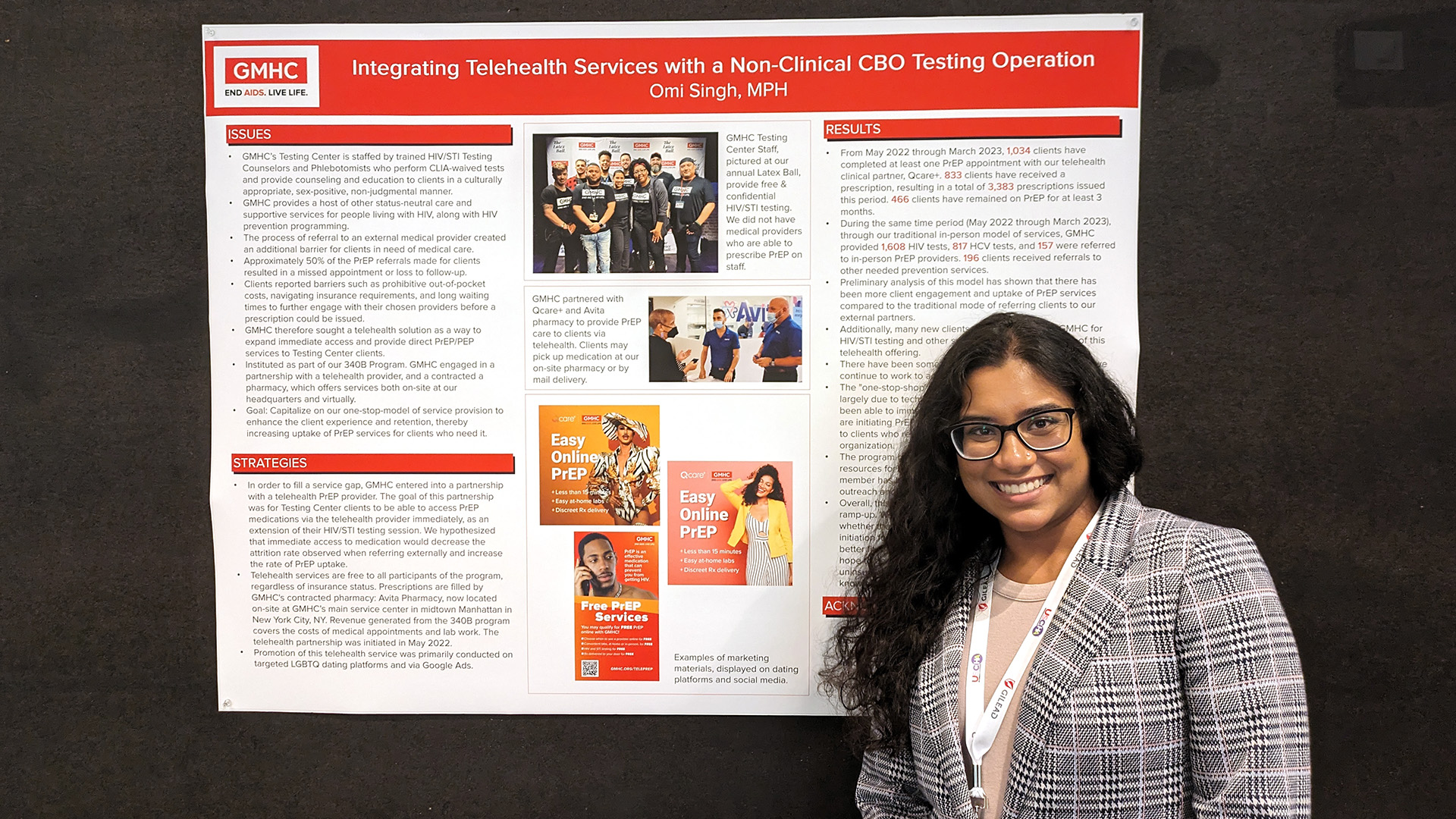
GMHC’s Testing Center administered 2,150 HIV tests and 8,000 STI tests to thousands of New Yorkers last year. Behind those numbers are a team of caring counselors educating New Yorkers about their sexual health.
“There is a lot of misinformation out there, so our goal is to counteract that,” says Omi Singh, Senior Director of Testing and Prevention Services. “Our counselors give people accurate, up to date information on ways to prevent HIV and STIs in a caring, nonjudgemental way, so New Yorkers feel empowered to take care of their health.”
During HIV and STI screenings, counselors educate clients about condom use, PrEP (pre-exposure prophylaxis), and PEP (post-exposure prophylaxis) for HIV prevention. For STI prevention, Doxy-PEP reduces the risk of chlamydia, gonorrhea, and syphilis when taken within 72 hours after sex.
“We take a holistic approach during counseling sessions with clients,” says Singh. “In addition to talking about sexual health, our counselors assess basic things people might need, like food, clothing, and shelter. They also ask about a client’s mental health, substance use, and potential intimate partner violence.”
“These are not easy conversations to have sometimes. People are already anxious about testing for HIV and STIs,” adds Singh. “Our counselors are really talented at making people feel comfortable enough to open up. Their empathy and ability to talk with people is really special. And our support staff make sure clients feel welcome when they walk in the door.
Qcare Plus Telehealth & PrEP Uptake
The Testing Center has connected over 2,100 active clients with Qcare Plus to access PrEP for HIV prevention through GMHC’s partnership with Qcare Plus to increase PrEP uptake. These clients can also obtain DoxyPEP via QcarePlus to reduce STI risks.
NYC Outreach
Testing Center counselors held 45 outreach events across the city last year to reach New Yorkers where they are. The team shows up at bars and clubs for events like Nowadays’ Body Hack party in Queens, conducts monthly HIV and STI testing at the TransLatinx Network in Manhattan, and holds regular on-campus screenings at the Manhattan School of Music, the CUNY Graduate Center in Manhattan, Lehman College in the Bronx, and other universities. And of course, the team is actively testing people and raising awareness about HIV and STIs at GMHC’s signature events AIDS Walk New York and the Latex Ball.
Research Impact
Testing Center staff published “HIV Self-Testing Knowledge, Attitudes, and Acceptance in New York City,” in the International Journal of STD & AIDS, to contribute to the research around this emerging approach to HIV testing.
During the COVID-19 shutdowns, GMHC pivoted to home self-testing kits and telecounseling to maintain testing services. In follow-up research, the Testing Center assessed the experiences of both self-testers and those who received in-person HIV tests. “Self-testing appeals to people for privacy and autonomy. It’s another tool we can provide people,” says Singh.